Four years of combination myopia control kept my son's eye growth close to that of a non-myopic eye. Learn about our results and why we switched from Ortho-K to Stellest lenses.
"Stellest is easier than Ortho-K before bed and in the morning," my son told me a few weeks after switching from his Ortho-K lenses to his new glasses.
Four years ago, my son was diagnosed with myopia at -2.50D, and soon after, we set sail on our myopia control journey with Ortho-K and 0.05% atropine. Since our year and a half update, a lot has happened: a growth spurt, a heavier school workload, and, this summer, a big change in his treatment plan.
I'm happy to share that his myopia is still under control, and his refractive errors are well managed. Whether you and your child are just starting or are years into your own myopia control journey, I invite you to read about our experience and what we have learned along the way.
Four years into our myopia journey
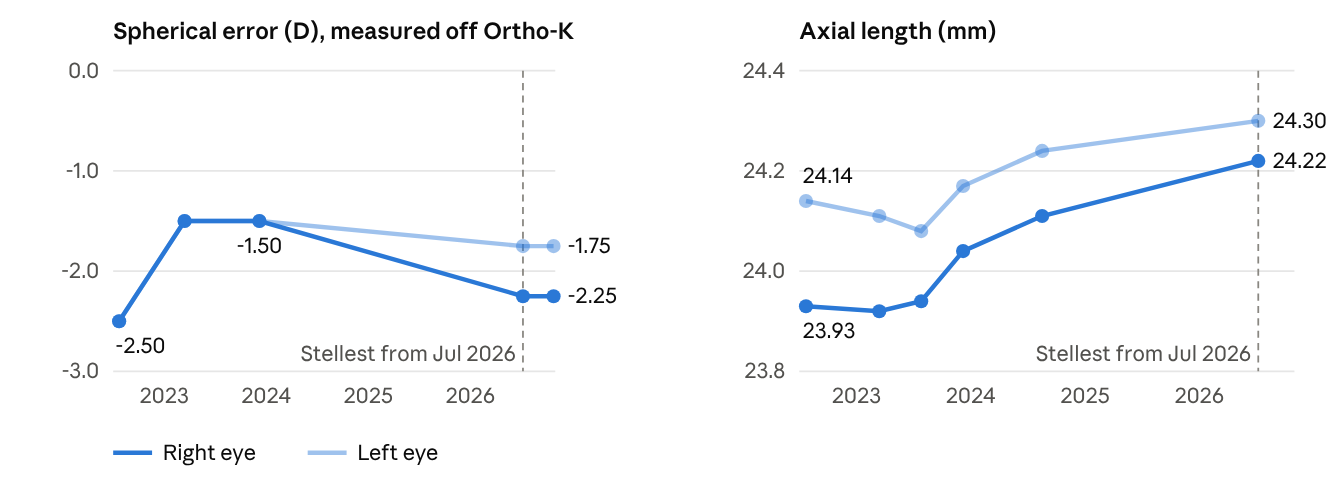
When my son was 8 years old, we initiated his myopia control treatment with spherical errors of -2.50D in both eyes and axial lengths of 23.93mm in the right eye and 24.14mm in the left eye. After eight months, his axial lengths had barely changed at 23.92mm and 24.11mm, and at 18 months, they were 24.04mm and 24.17mm.
Since then, we have had several more checkups. In August 2024, his axial lengths were 24.11mm and 24.24mm. At his latest measurement in July 2026, now after 4 years, they are 24.22mm in the right eye and 24.30mm in the left eye.
His spherical errors are now -2.25D in the right eye and -1.75D in the left eye, compared with -2.50D in both eyes when he started treatment. Over four years, his eyes have grown by only about 0.07mm/year in the right eye and 0.04mm/year in the left eye.
Results of our myopia control efforts
To evaluate whether my son's treatment is working, I use the same approach I described in how fast does nearsightedness progress: compare his axial length growth with that of myopic and non-myopic children of the same age.
For myopic children aged 8 to 11, the typical axial growth is about 0.3mm/year, slowing to about 0.17mm/year between 13 and 16.1,2 For children without myopia, it is about 0.14mm/year between 8 and 10 and 0.09mm/year between 11 and 14.1
Since our last update in December 2023, my son's axial lengths grew by +0.18mm and +0.13mm over about two and a half years, which is about 0.07mm/year and 0.05mm/year. Between August 2024 and July 2026, the rate slowed further to about 0.06mm/year and 0.03mm/year. In other words, his eyes are growing at, or even slower than, the pace of non-myopic eyes his age. When I set a goal of about 0.09mm/year at age 11, I was hopeful but not sure we could get there. I am thrilled that we did.
However, the spherical error chart tells a more complicated story. When he stopped Ortho-K this summer, his spherical errors came back at -2.25D in the right eye and -1.75D in the left eye, compared to the -1.50D in both eyes (after washout Ortho-K's effect) that we saw in 2023.
At first glance, this looks like progression. Yet his axial length barely grew, and his prescription is still slightly lower than the -2.50D he started with. I can't fully explain the difference, and I find that fascinating. If your child's numbers ever surprise you, don't panic over a single result. The human body is sophisticated. Stay consistent with the right habits and treatment, and talk with your eye doctor about what the results mean as a whole.
It's also worth noting that refractions are reported in 0.25D steps and cycloplegic refraction is rarely used in the US, so small differences between visits are expected. The right eye did grow more than the left (+0.29mm vs. +0.16mm), which is something we will keep an eye on with his doctor.
Nearsightedness management: from Ortho-K to Stellest
As a quick recap, we chose a proactive approach from the start, combining Ortho-K with 0.05% low-concentration atropine. Given my son's Asian ancestry and our family history of high myopia, we wanted two treatments working through different mechanisms — peripheral defocus and the dopamine signaling pathway — rather than waiting to see if one was enough.
For four years, Ortho-K served him well. Over time, he took over handling his own lenses. But over the past year, several things made me rethink our choice:
- Allergies: During allergy season, my son sometimes had eye discomfort or red eyes and would skip Ortho-K for a night or two. Each skipped night worried me.
- Monitoring: Axial length remains the most important measurement, but I also wanted to keep a close eye on his refractive errors without pausing Ortho-K for a month before every checkup.
- School workload: With more schoolwork, he needed simpler routines before bed and in the morning. And honestly, it gives me peace of mind not to worry about his lens hygiene habits.
- The evidence: A recent retrospective study comparing different treatments combined with low-dose atropine found that children wearing highly aspherical lenslet (HAL) glasses with atropine had the least axial growth after one year, about 0.08mm, compared with 0.18mm for Ortho-K with atropine.3
After talking it over with my son, we made the switch this summer during his trip back to Taiwan, where he visited Dr. Lin, the doctor who helped us start our myopia control journey four years ago. My son continued 0.05% atropine every night and switched from Ortho-K to Stellest spectacle lenses. Both MiyoSmart and Stellest are great options; we chose Stellest because it was readily available at Dr. Lin's clinic.
Stellest lenses have a clear center zone that corrects his vision, surrounded by rings of tiny lenslets that create a signal of myopic defocus to slow eye growth. In a clinical trial, children wearing them had 67% less myopia progression and 64% less eye growth than those in regular glasses after one year.4 Additionally, a five-year follow-up study results showed the lenses kept working, preventing the equivalent of about three years of myopia progression.6
The lenses were shown in studies to work best when worn at least 12 hours a day,5 even though the manufacturer recommended at least 10 hours a day and 6 days per week.9 Unlike Ortho-K, which works while he sleeps, glasses only work when they are on his face. Fortunately, my son wears his Stellest glasses full time, from when he wakes up until he goes to bed.
The adjustment was easy. At first, they felt different, just like getting a new pair of glasses, but he has not noticed marked difference in blurriness in his peripheral vision. When I asked him how he felt about wearing glasses all day after four years of Ortho-K, he shrugged: "It is okay. Even though with Ortho-K I didn't have something I had to wear, it is no big deal."
Alongside the treatments, we have kept up our lifestyle measures, though not always as well as I'd like:7
- Outdoor Time: With more schoolwork, his outdoor time has decreased to about 60-70 minutes per day during the school year. During summer break, we try to keep it to about 90 minutes per day.
- Swimming: He still loves swimming. During the summer, he swam at an outdoor pool for about 2 hours, once or twice a week, which also added to his outdoor time. Since school started, it has become a weekly 45-minute swim at an indoor pool.
- Eye Breaks: He takes a 5- to 10-minute break after every 30-40 minutes of schoolwork (occasionally up to 60 minutes), either closing his eyes, looking at something far in the distance, or simply getting up for some water, a snack, or a trip to the bathroom.
- Big Screen, Farther Away: Instead of doing schoolwork on his Chromebook or playing games on his iPad, he projects his screen onto our TV. The larger screen sits farther away, which cuts down on close-up work for his eyes.
- Stellest Wear Time: Full time, all day long, from waking up to bedtime.
Conclusion
In our four-year myopia journey, a proactive strategy of combination treatment, adjusted as his needs changed and complemented by lifestyle measures like outdoor time and eye breaks, has kept my son's eye growth close to that of a non-myopic eye.
Switching treatments is not a step back. As our children grow, their needs change, and their myopia control plan should change with them.
It's important to remember that myopia control is a collaborative effort involving parents, healthcare professionals, and the child. Ongoing communication with the doctor, vigilant monitoring, adjusting the treatment plan as necessary, and fostering healthy eye habits are paramount for success.
By adopting an appropriate myopia treatment with your healthcare professional, you can empower your child to maintain clear vision and slow or even stop myopia from progressing. I wish you and your child all the best in your myopia control journey.
Want to stay connected on the newest happening? Join me
Facebook group: www.facebook.com/groups/myopia/
Comments